
Vancouver Public Schools
Our 2025-26 Budget Development
Our 2025-26 budget
Each year, we enter into a budget planning process in order to deliver on our commitment to serving our students.
There is an ongoing Board Budget Committee, and we provide updates about the budget process each month at our School Board Meetings. The typical timeline for budget approval is:
- March Board Meeting: Overview
- Board Budget Committee: Ongoing
- April Board Meeting: Update on major variables
- Mid-April: Legislative Session Ends
- May: Staffing/Schedule development
- Mid-May Board Meeting: Recommendations made to the board
- June/July Board Meeting: Final recommendations made to the board; preview final budget outcomes
- August Board Meeting: Public hearing, final budget adoption
Budget feedback and updates we have shared:
For the 2025-26 school year, there are several key considerations when it comes to our budget:
Enrollment numbers
A rapidly increasing gap between state funding and actual costs, particularly related to:
- Special education services
- Materials, Supplies, and Operating Costs
- Insurance
- Inflation
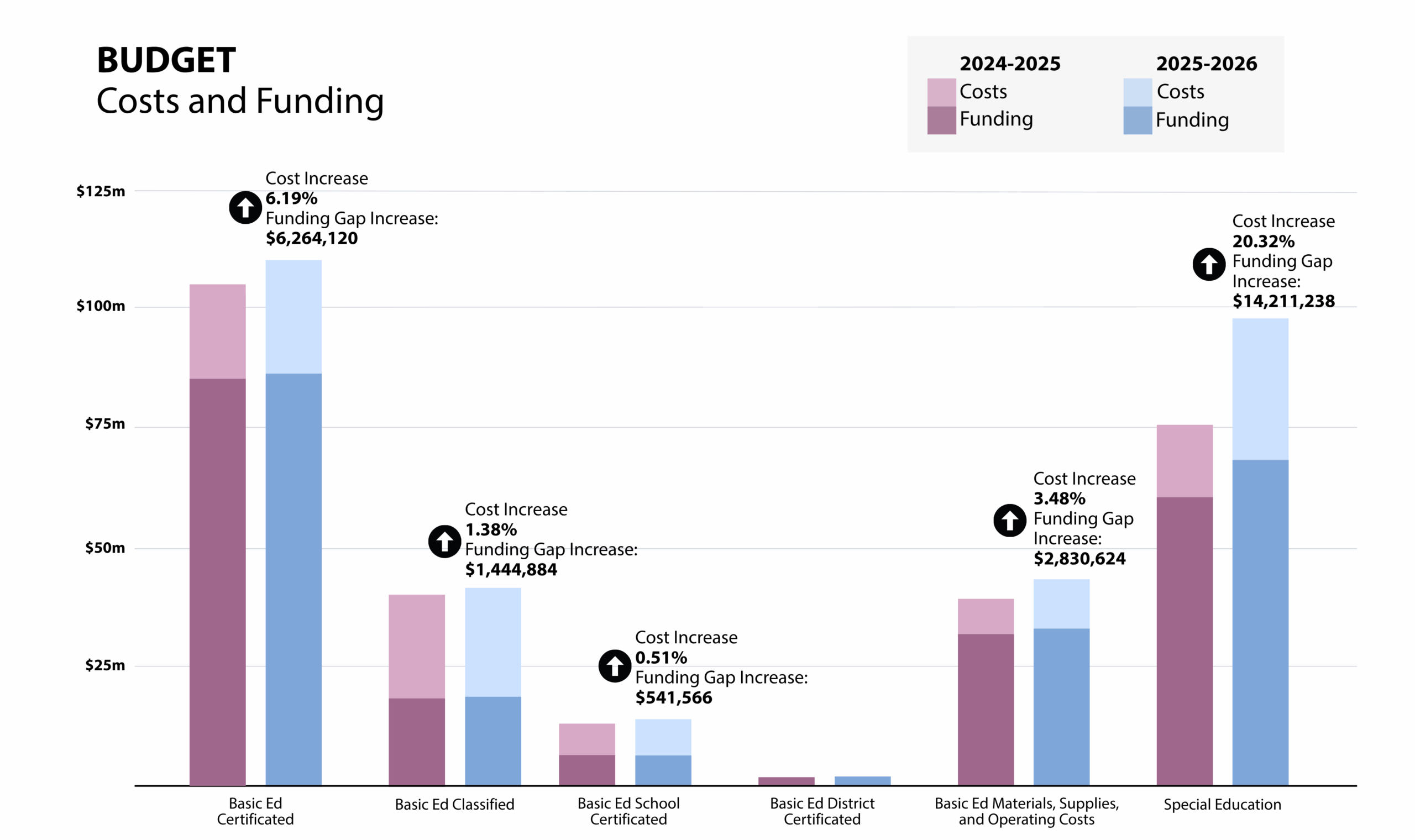
This graph shows the gap between our state funding and estimated actual costs–both for staff and operating costs–for the 2024-25 and 2025-26 school year. The gap continues to grow between the level of funding we receive and actual costs to run our schools.
Federal funding uncertainty
There is a great deal of uncertainty related to the upcoming federal funding of K-12 education, and school districts across the state are anticipating major reductions.
Based on proposed cuts to education funding in the current proposed federal budget, key programs affected by the proposed cuts include:
- Title I, Parts A, B, and D remain largely intact
- Title I, Part C (Migrant education) – eliminated
- Title II (Professional learning), Title III (English Language Learners), and Title IV (After school and other “equity” programs) appear to get consolidated with other programs and take about a 70% cut
- Other programs included in the program consolidation and 70% cut are
- School safety grants
- Support for at-risk youth in institutions
- Students experiencing homelessness (McKinney-Vento)
- Title V (Rural flexibility) is maintained
- Title VI (Native education) is maintained
- Title VII (Impact aid) is maintained
- School meals via USDA appears to reduce some CEP funding
- IDEA remains largely intact
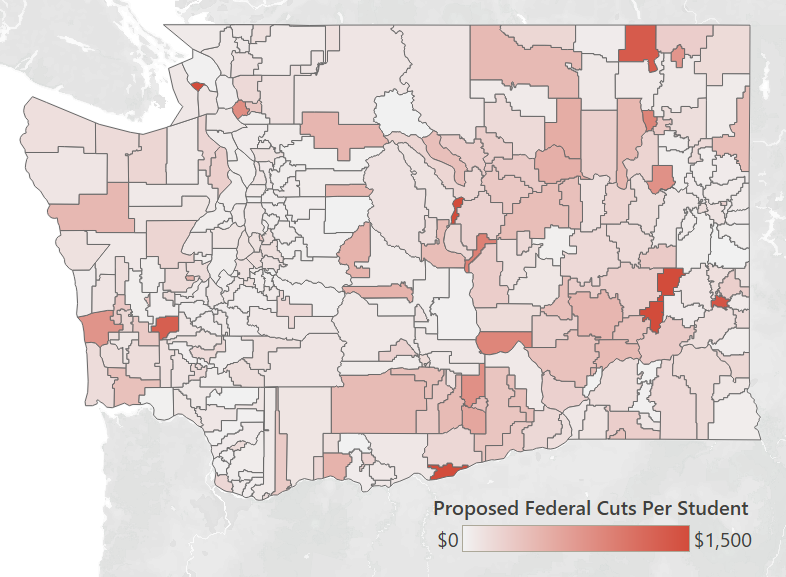
OSPI has posted an interactive map with the projected cuts by school district. Click the image to see OSPI’s page with more information and the interactive map.
You can help us by learning more about the current school funding crisis and advocating to our legislators. Thank you for being committed to the success of our Vancouver Public Schools students.
Frequently asked questions about the 2025-26 budget
The statewide transition of school employees to SEBB for employee health insurance created significant cost increases compared to the previous system. Additionally, the McCleary ruling, combined with an extremely competitive job market for qualified staff, have dramatically increased wage levels. While state funding has also increased at higher-than-normal levels, it has not kept up with the necessary wage increases bargained by all of our employee groups and inflation.
We have decreased the staffing level and costs at the central office over the last several years, and the percentage of staff cut at Central Office was the highest of any employee group during the reduction in force for the 2024-25 school year. This table shows recent trends in VPS Central Office staffing, along with statewide averages. We have worked to repurpose previous roles, such as Deputy Superintendent, to positions that directly support schools with learning and operations. This analysis does not include teachers on special assignment (TOSAs) who may have desks in the Central Office, but their work, and often their funding source, is dedicated to a specific instructional program.
There are a few factors that create the difference between what the state funds for VPS staffing and actual VPS staffing costs:
- We employ more positions than the state says we need, based on their formula that predicts what a typical school needs, for example (but not limited to) additional teachers to lower class sizes and safety personnel.
- The actual cost to pay the salary and benefits for each position costs more than the state funds, based on the state’s calculation formula
- Our projections for the total cost of our current staffing levels compared to what the state will fund next year (based on 2024-25 budget assumptions) are summarized here.
This graph shows the gap between our state funding and estimated actual costs–both for staff and operating costs–for the 2024-25 and 2025-26 school year. The gap continues to grow between the level of funding we receive and the actual costs to run our schools.